Biological Age vs Chronological Age: What the Tests Measure (and What They Don't)
Your biological age might read younger or older than your birth certificate. Here's what these tests actually measure, and where the science still has real limits.
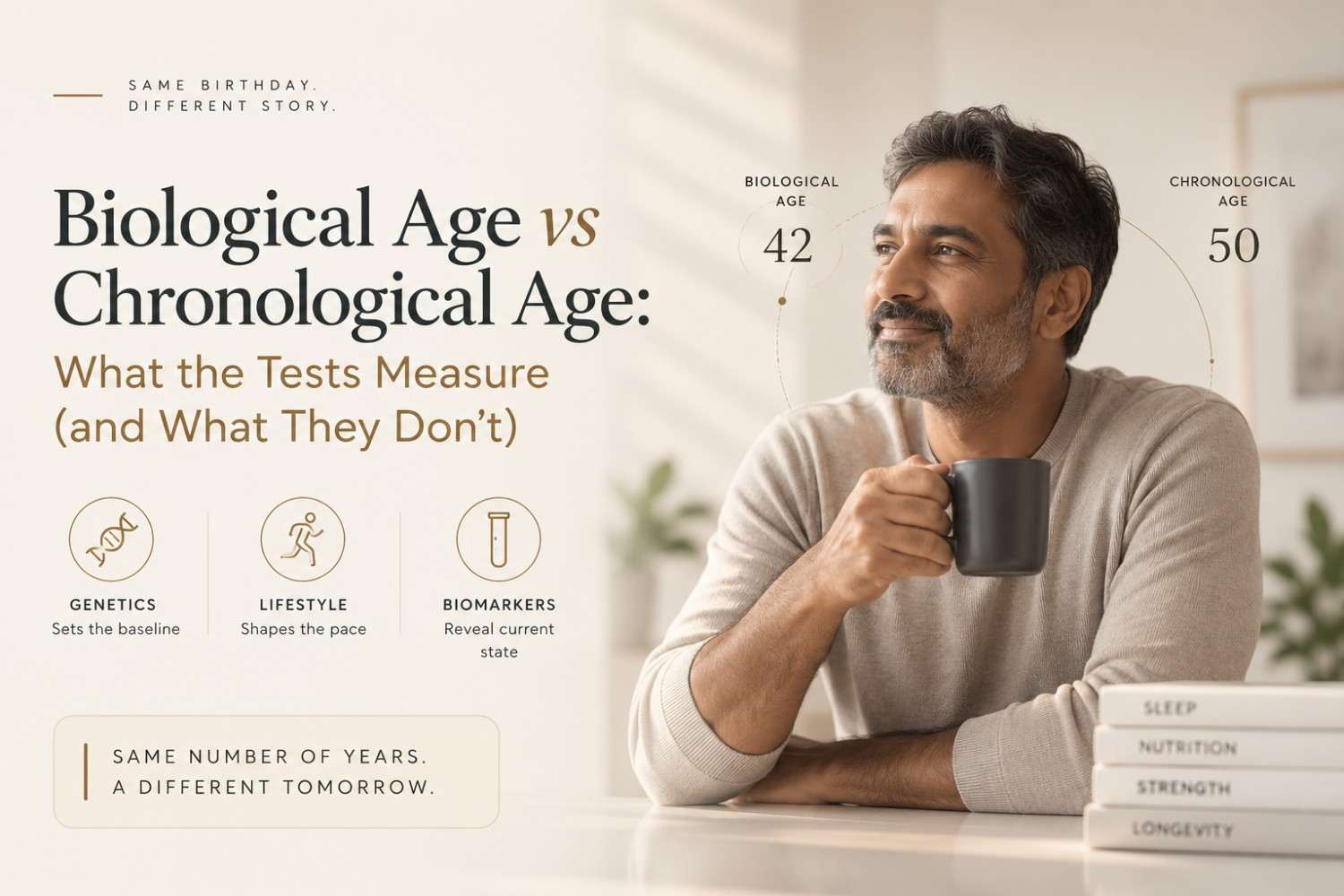
Chronological age is simple: it's the number of years since you were born, and it only moves in one direction. Biological age is a different, more contested idea: an estimate of how "old" your body actually is, functionally, based on measurable markers rather than your birth date. Two 45-year-olds can have meaningfully different biological ages depending on how their cells, organs, and systems have actually been aging — and, at least in principle, biological age is something you can influence.
How Biological Age Is Estimated
There is no single, universally agreed-upon test. Instead, several different approaches are used, each measuring a different layer of aging:
Epigenetic Clocks
These analyse chemical modifications (DNA methylation patterns) on your DNA that change in predictable ways with age, and in less predictable ways depending on lifestyle and health. Several well-studied epigenetic clocks exist in research settings, and some have been commercialised for direct consumer use. They correlate reasonably well with chronological age at a population level, but their accuracy and actionability for a single individual, and how well they respond to specific interventions, remains an active area of research rather than a settled science.
Biomarker-Based Composite Scores
These combine multiple blood markers, such as inflammatory markers, metabolic markers, kidney and liver function, and blood counts, into a single composite score, using population data to estimate how "old" your combined profile looks relative to your peers. These tend to be more grounded in markers your physician can act on directly.
Functional Measures
Grip strength, VO2 max (aerobic fitness capacity), walking speed, and muscle mass are, in some respects, the most practically useful proxies for biological aging, because a large body of long-term cohort research links each of them directly to future health outcomes and mortality risk. We cover these in detail in our article on free longevity predictors.
Being Honest About the Limits
It is worth saying plainly: biological age testing, particularly epigenetic clock testing, is a genuinely promising but still-maturing field. A single test result should be treated as an interesting, motivating data point rather than a precise medical verdict. Test-retest variability exists, different clocks can give meaningfully different answers for the same person, and the science of how reliably these markers respond to a specific intervention, versus simply reflecting overall health status, is still being worked out. Anyone promising a biological age number accurate to the month, or claiming a specific supplement will "reverse" your biological age by a precise amount, is overstating what the current evidence supports.
What's Actually Actionable Regardless of the Test
The genuinely useful part of biological age testing isn't the single number, it's what reliably moves it in the right direction, and the encouraging news is that this list is well established regardless of which specific test you use: regular resistance and aerobic exercise, adequate protein intake, consistent quality sleep, not smoking, maintaining a healthy body composition, and managing chronic stress. These same factors show up consistently across virtually every study of biological aging markers, which is a stronger signal than any single test result.
At iMedi, we use biological age testing as one input among several, alongside functional fitness measures and blood biomarkers, within our longevity programme, rather than as a standalone verdict, and alongside complementary options like NAD+ therapy for those specifically interested in the cellular-aging side of longevity medicine.
How to Interpret a Result That Surprises You
It's common to receive a biological age result that reads noticeably older or younger than expected, and the right response depends on which type of test produced it. A single epigenetic clock reading that seems alarmingly high is worth discussing with a physician rather than reacting to in isolation, particularly given the test-retest variability described above; a repeat test some months later, alongside a review of sleep, activity, and blood biomarkers, gives a far more reliable picture than one number taken at face value. Conversely, a result that reads younger than expected shouldn't be treated as a licence to abandon healthy habits — the same lifestyle factors that produced a favourable reading are generally what's needed to maintain it.
The most useful way to use any biological age test is longitudinally: as a way to track whether your own trajectory is improving or worsening over one to two years of consistent habits, rather than as a one-time score to be compared against other people or treated as a fixed diagnosis.
Biological Age Testing Availability in India
Biological age testing, in some form, is increasingly available through longevity-focused clinics and a small but growing number of specialised labs in India, typically offered as either a standalone blood-based or epigenetic test, or bundled within a broader preventive health assessment. Given the field's current limitations, it's worth choosing a provider who presents the result alongside actionable blood biomarkers and functional fitness measures, rather than one offering the number in isolation with no clinical interpretation or follow-up plan attached.
It's reasonable to ask any provider offering a biological age test which specific method they use, what its published test-retest reliability looks like, and how the result will be translated into an actual action plan. A provider unable to answer these questions clearly is generally a sign that the test is being sold as a novelty rather than integrated into genuine clinical care.
Frequently Asked Questions (FAQs)
1. Does one bad result mean I am aging faster than normal?
Not necessarily. Given test-retest variability, a single result is best treated as a prompt to look at your overall lifestyle and to retest later, rather than a definitive verdict on your rate of aging.
2. Is biological age testing scientifically reliable?
It's a genuinely promising and active area of research, but current tests, particularly epigenetic clocks, have real limitations around test-retest reliability and consistency between different testing methods. Results are best treated as one data point among several, not a precise verdict.
3. Can biological age actually be lowered?
Some studies suggest certain biological age markers can improve with sustained lifestyle changes, but the science of exactly how much and how reliably is still developing. The underlying habits that appear to help, exercise, sleep, and body composition, are well established regardless.
4. What's the difference between an epigenetic clock and a biomarker-based score?
Epigenetic clocks analyse chemical changes on your DNA, while biomarker-based scores combine multiple blood test results into a composite. Both aim to estimate biological aging but use different underlying data.
5. Are functional measures like grip strength a good proxy for biological age?
Yes, and in some ways more practically useful, since large long-term studies link grip strength, VO2 max, and walking speed directly to health outcomes and mortality risk, with a well-established evidence base.
6. How often should biological age be retested?
Given test-retest variability, testing once a year is generally sufficient to track meaningful trends rather than short-term noise.
7. Should I be worried if my biological age is higher than my chronological age?
It's worth discussing with a physician and using as motivation to review the actionable factors, exercise, sleep, diet, and stress, rather than a cause for alarm on its own.
This article is for educational purposes and does not replace personalized medical advice. Please consult a qualified physician before making changes to your treatment, medication, or health screening plan.