Continuous Glucose Monitors and Healthy Adults: Useful Tool or Unnecessary Noise?
Continuous glucose monitors can reveal patterns, but more data does not always mean better decisions. Here is how healthy adults can use CGMs thoughtfully.
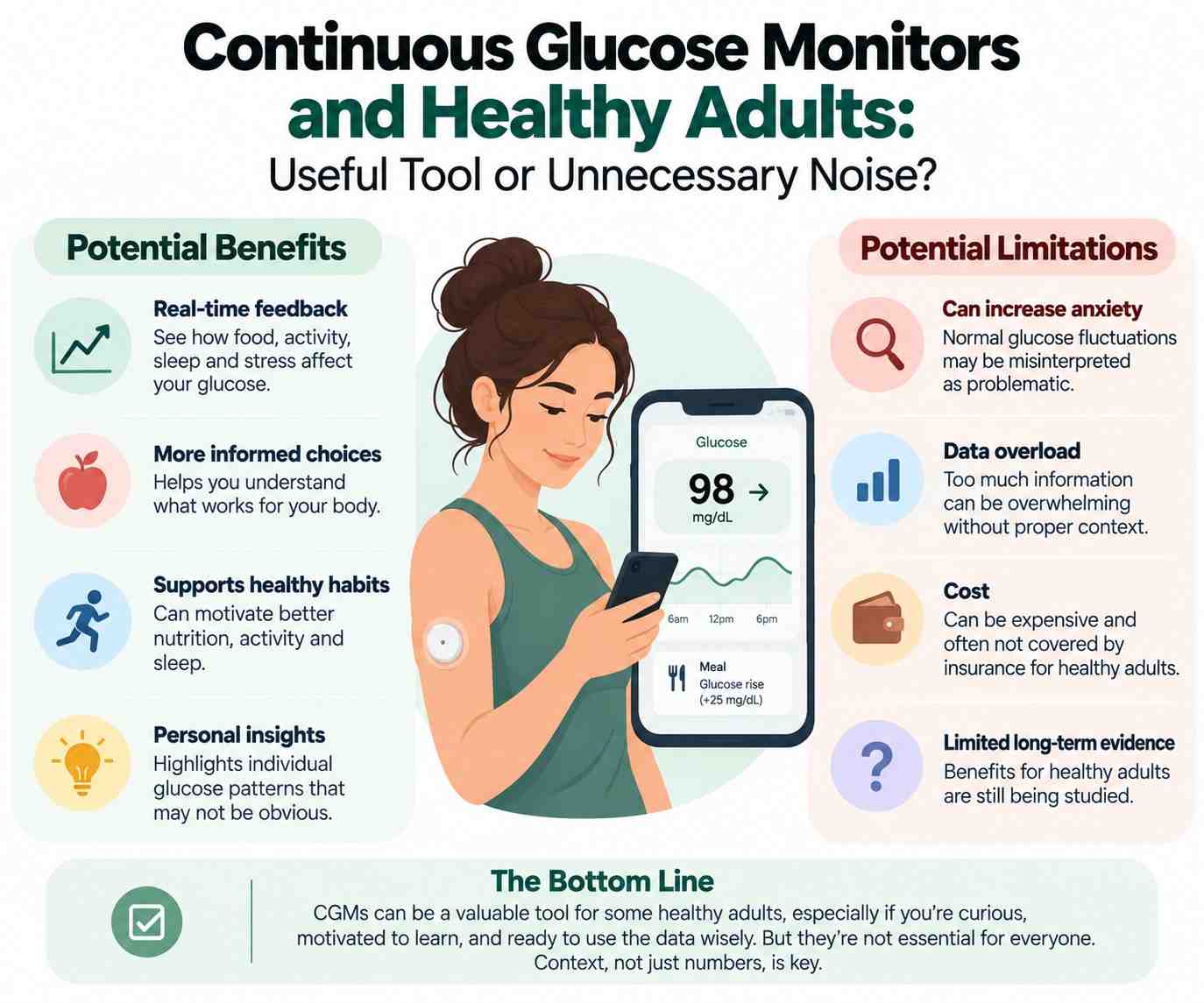
Continuous glucose monitors, small sensors worn on the skin that track glucose levels throughout the day and night, were originally developed for people with diabetes. In recent years they have become popular among healthy adults interested in optimising metabolic health, raising a genuine question: does a CGM provide meaningful, actionable information for someone without diabetes, or does it mostly generate data without a clear way to act on it?
How a CGM Works
A small sensor, typically worn on the back of the upper arm or the abdomen, measures glucose in the interstitial fluid just beneath the skin and transmits readings to a paired app every few minutes, continuously, for one to two weeks per sensor. This gives a far more detailed picture of glucose fluctuations throughout the day than a single fasting blood draw, showing exactly how specific meals, exercise, sleep, and stress affect glucose in near real time.
What a CGM Can Reveal in a Healthy Adult
Even in someone without diabetes, a CGM can reveal which specific foods and meal combinations produce larger glucose spikes, how exercise timing affects post-meal glucose response, how poor sleep or stress affects glucose stability the following day, and general patterns in glucose variability across the day and night. For someone motivated to fine-tune diet and lifestyle based on their own individual data, rather than generic nutrition advice, this can be genuinely useful, personalised information.
Where the Value Becomes Less Clear
Glucose variability that would be considered clearly abnormal in a diabetic context is not necessarily meaningful in someone with normal fasting insulin, HbA1c, and HOMA-IR. Reference ranges and interpretation guidelines for CGM data in non-diabetic individuals are still less well established than for diabetes management, meaning some readings that appear concerning on an app's dashboard may not actually reflect meaningful metabolic risk, and can create unnecessary anxiety without professional interpretation.
Who Is Most Likely to Benefit
People with early insulin resistance, elevated fasting insulin or HOMA-IR, prediabetes, or a strong family history of type 2 diabetes are more likely to gain clinically useful information from CGM data, since patterns of glucose variability in these groups more directly reflect emerging metabolic dysfunction. For someone in this category, a CGM used alongside standard blood testing, covered in our article on the metabolic health checkup and biomarkers beyond HbA1c, can add a genuinely useful layer of personalised, real-time detail.
Who May Get Less Practical Value
For a healthy adult with normal fasting insulin, HbA1c, and no metabolic risk factors, a CGM often produces interesting but not clinically actionable data, small glucose fluctuations that fall within a broadly normal range but appear notable on a graph. Without professional guidance to interpret what is and is not clinically meaningful, this can lead to unnecessary dietary restriction based on normal physiological variation rather than genuine metabolic dysfunction.
Using CGM Data Alongside Standard Testing, Not Instead Of
A CGM is best used as a complement to, not a replacement for, standard blood testing including fasting insulin, HOMA-IR, and HbA1c. These blood tests provide validated, well-understood reference ranges, while CGM data adds a personalised, real-time dimension showing how specific foods and behaviours affect an individual's glucose day to day. Together, they provide a more complete picture than either alone.
Practical Ways to Use a CGM if You Choose One
Focus on identifying your own personal patterns, which specific foods or meal combinations produce the largest spikes for you, rather than comparing your graph to generic online benchmarks or another person's data. Reviewing patterns with a physician or qualified professional who understands both CGM data and your broader metabolic testing gives considerably more useful, actionable insight than interpreting the app's dashboard alone.
A Reasonable Way to Decide If a CGM Is Worth It for You
If you have known risk factors for insulin resistance, elevated fasting insulin, prediabetes, PCOS, or a strong family history of diabetes, a CGM used alongside professional guidance can add genuine value. If you are otherwise healthy with normal standard metabolic markers and are mainly curious, a CGM can still be interesting, but expectations should be realistic about how much additional actionable information it will provide beyond standard testing and a well-structured diet and exercise routine, covered in our related articles on muscle and glucose control and metabolic flexibility.
Discuss Whether a CGM Is Right for You
Frequently Asked Questions (FAQs)
1. Do I need a prescription to use a continuous glucose monitor?
Requirements vary by product and region; some CGMs are available over the counter for general wellness use, while others require a prescription, particularly for diabetes-specific devices.
2. How long does a single CGM sensor last?
Most sensors last between one and two weeks before needing replacement, depending on the specific device.
3. Can a CGM diagnose prediabetes or diabetes on its own?
No, diagnosis relies on standard blood tests like fasting glucose, HbA1c, and an oral glucose tolerance test; CGM data can support but not replace formal diagnostic testing.
4. Are glucose spikes on a CGM always a sign of a problem in a healthy person?
Not necessarily; some glucose variability is normal physiological response to food and activity, and not every spike shown on a CGM graph indicates a metabolic problem, particularly in someone with otherwise normal blood test results.
5. Can a CGM help identify specific foods that spike my glucose more than others?
Yes, this is one of the more genuinely useful applications, helping identify individual, personalised responses to specific foods rather than relying on generic dietary advice alone.
6. Is CGM data as reliable as a laboratory blood glucose test?
CGM measures glucose in interstitial fluid, which correlates closely with but is not identical to blood glucose, and can lag slightly behind rapid changes, making it a useful trend tool rather than a substitute for precise lab measurement.
7. Should I stop using a CGM if the data makes me anxious?
If CGM data is creating anxiety without clear clinical benefit, discussing the data with a physician, or stepping back from continuous monitoring in favour of standard periodic testing, is a reasonable choice.
This article is for educational purposes and does not replace personalized medical advice. Please consult a qualified physician before making changes to your treatment, medication, or health screening plan.