hs-CRP Explained: The Simple Blood Test Most Health Packages Skip
hs-CRP costs less than a cup of coffee to test and is one of the most useful markers for explaining fatigue, joint aches, and hidden cardiovascular risk.
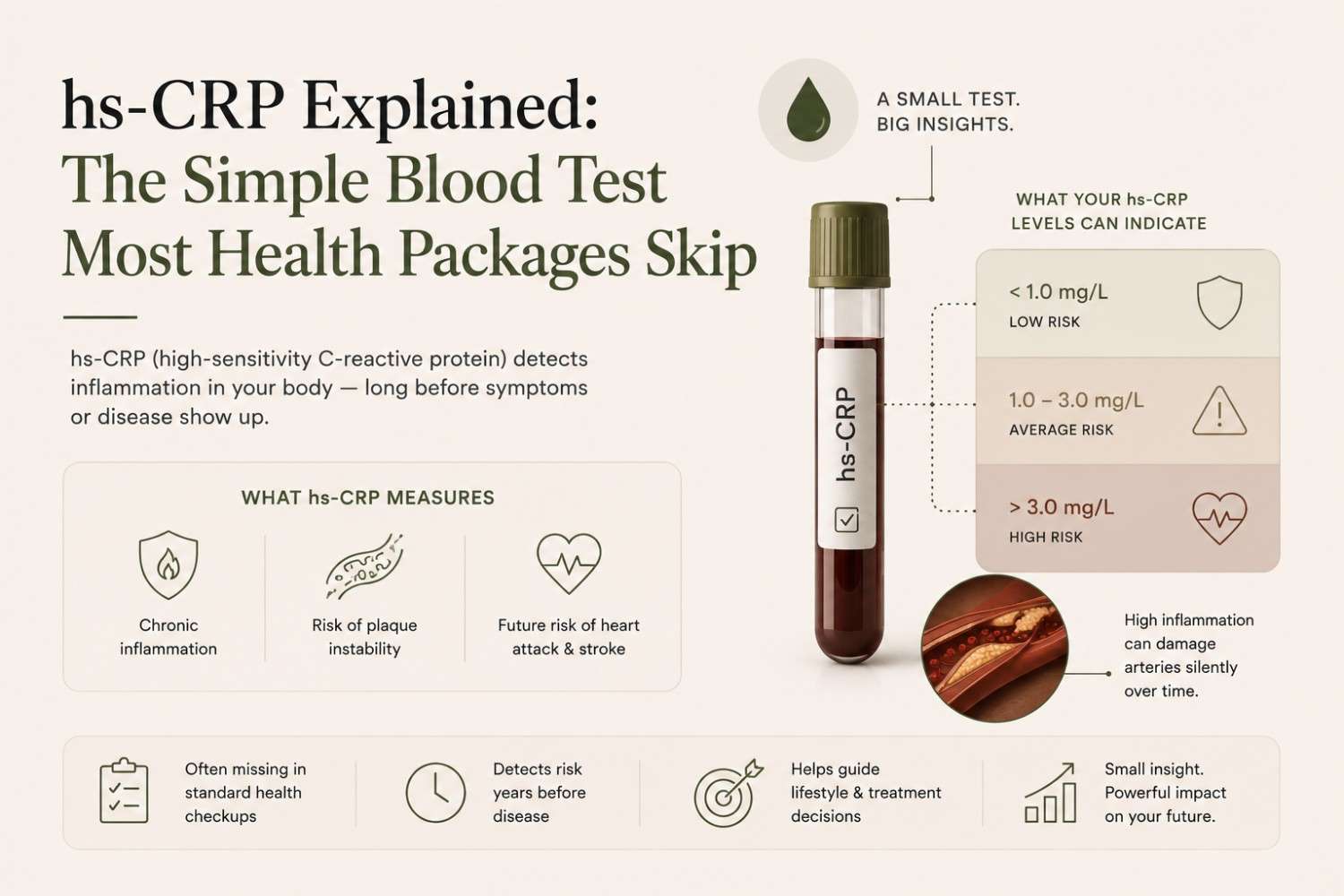
C-reactive protein (CRP) is produced by the liver in response to inflammation anywhere in the body. A regular CRP test, sometimes included in a standard health package, is designed to detect acute inflammation — an infection, an injury, an active flare of a condition like arthritis. The high-sensitivity version of the same test, hs-CRP, is calibrated to detect something different and, for preventive purposes, more useful: chronic, low-grade inflammation that produces no obvious symptoms at all.
Why Low-Grade Inflammation Matters
Chronic low-grade inflammation is now understood to play a role in the development of atherosclerosis (the buildup of plaque in artery walls), insulin resistance, and a range of other conditions typically associated with aging. It doesn't announce itself the way acute inflammation does — there's no fever, no obvious swelling — but it shows up reliably in hs-CRP, and elevated levels have repeatedly been associated with higher cardiovascular risk in large population studies, independent of cholesterol levels.
Reading Your hs-CRP Number
Most labs report hs-CRP in mg/L, with results broadly interpreted as:
Below 1.0 mg/L — low cardiovascular risk category.
1.0 to 3.0 mg/L — average or intermediate risk category.
Above 3.0 mg/L — higher risk category, warranting further evaluation.
Above 10 mg/L — usually reflects an acute process (infection, injury, or active inflammatory condition) rather than baseline chronic inflammation, and the test is typically repeated once that resolves.
What Actually Raises hs-CRP
A long list of common, everyday factors contribute to chronically elevated hs-CRP: excess visceral fat (adipose tissue itself produces inflammatory signalling molecules), poor sleep quality and duration, chronic psychological stress, smoking, a diet high in refined carbohydrates and industrial seed oils, gum disease, and untreated insulin resistance. This is part of why hs-CRP is often the biochemical explanation behind vague, hard-to-pin-down symptoms like persistent low energy, joint aches without an obvious cause, or a general sense of being run down — symptoms that a standard checkup, as covered in our guide to what a normal blood test misses, frequently can't explain.
Lowering Chronic Inflammation
The good news is that hs-CRP responds relatively quickly and reliably to lifestyle intervention, often more so than some other biomarkers:
Reducing visceral fat, even modestly, tends to produce a measurable drop in hs-CRP within weeks to months.
Prioritising 7–8 hours of consistent sleep has a direct, well-documented effect on inflammatory markers.
Regular moderate exercise lowers hs-CRP, though very intense or excessive training without adequate recovery can temporarily raise it.
Reducing ultra-processed food and increasing omega-3 intake (fatty fish, walnuts, flaxseed) has a modest but real anti-inflammatory effect.
Addressing dental and gum health is an underrated contributor that's frequently overlooked.
hs-CRP is one of the least expensive tests to add to any checkup and one of the most informative, which is exactly why it is included as standard in every preventive health assessment at iMedi rather than treated as an optional extra.
hs-CRP vs Other Inflammatory Markers
hs-CRP is not the only marker of systemic inflammation, but it has become the most widely used in preventive medicine because it is inexpensive, well standardised across labs, and backed by decades of population research linking it to cardiovascular outcomes. Other markers, such as interleukin-6 (IL-6), homocysteine, and erythrocyte sedimentation rate (ESR), can provide additional information in specific clinical situations, but they are typically reserved for cases where hs-CRP results are unclear or where a specific inflammatory condition is already suspected, rather than used as first-line screening tools. For most people, hs-CRP alone provides a reasonable, cost-effective starting point.
When Not to Test hs-CRP
Timing matters. Testing hs-CRP during or immediately after an acute infection, a recent injury, a vaccination, or a flare of an inflammatory condition like arthritis will produce an artificially elevated result that reflects the acute event rather than your baseline inflammatory state. It's generally best to test when you are feeling well and free of any acute illness, and if your result comes back unexpectedly high above 10 mg/L, the right next step is usually to repeat the test after two to three weeks rather than immediately assuming chronic disease risk.
hs-CRP Alongside Your Lipid Panel
hs-CRP becomes considerably more useful for cardiovascular risk assessment when read together with your lipid markers rather than on its own. A person with borderline LDL cholesterol or ApoB and an elevated hs-CRP represents a meaningfully different risk picture than someone with the same lipid numbers and a low hs-CRP, since inflammation appears to play a direct role in how readily cholesterol particles contribute to arterial plaque formation. Our related article on ApoB and cardiovascular risk covers the lipid side of this picture in more depth, and the two markers are genuinely complementary rather than redundant, which is why both are included together in a proper preventive cardiovascular workup.
Gum disease deserves a specific mention here, since it's a commonly overlooked and easily fixable contributor to chronically elevated hs-CRP. Periodontal inflammation releases inflammatory mediators into the bloodstream continuously, and treating underlying gum disease has been shown in several studies to measurably lower hs-CRP, which is one more reason a dental check is a reasonable part of the workup when hs-CRP is unexpectedly elevated with no other obvious cause. A simple dental review, alongside the lifestyle factors already covered, is often overlooked precisely because inflammation is assumed to be purely a cardiovascular or metabolic issue rather than something that can originate in the mouth and travel throughout the rest of the body via the bloodstream.
Frequently Asked Questions (FAQs)
1. Can hs-CRP be too low?
Very low hs-CRP is not typically a concern on its own and generally reflects low baseline inflammation, which is favourable rather than something to correct.
2. What is a normal hs-CRP level?
Below 1.0 mg/L is generally considered low cardiovascular risk, 1.0-3.0 mg/L average risk, and above 3.0 mg/L higher risk, though your physician will interpret this alongside your broader health picture.
3. Can hs-CRP be high without any symptoms?
Yes, this is the whole point of the test. Chronic low-grade inflammation typically produces no obvious symptoms, which is why it needs to be measured rather than felt.
4. Does hs-CRP go up with a common cold or minor infection?
Yes, acute infections and injuries can temporarily raise hs-CRP significantly. It's best tested when you are not acutely unwell, and very high results (above 10 mg/L) are usually repeated after recovery.
5. Can exercise raise hs-CRP?
A single intense workout can cause a brief, temporary rise as part of normal tissue repair. Regular moderate exercise over time, however, is associated with lower baseline hs-CRP.
6. How is hs-CRP different from the CRP test in a routine checkup?
hs-CRP uses a more sensitive assay designed to detect the low levels associated with chronic inflammation, whereas a standard CRP test is calibrated for detecting acute infection or inflammation.
7. How quickly can hs-CRP improve?
Meaningful reductions are often seen within 8-12 weeks of consistent changes to sleep, diet, activity, and body composition, though the exact timeline depends on the underlying cause.
This article is for educational purposes and does not replace personalized medical advice. Please consult a qualified physician before making changes to your treatment, medication, or health screening plan.