ApoB vs LDL Cholesterol: Why Your Lipid Profile May Be Hiding Your Real Heart Risk
Two people can share an identical LDL number and carry very different heart disease risk. ApoB explains why, and it's a test almost nobody in India has heard of.
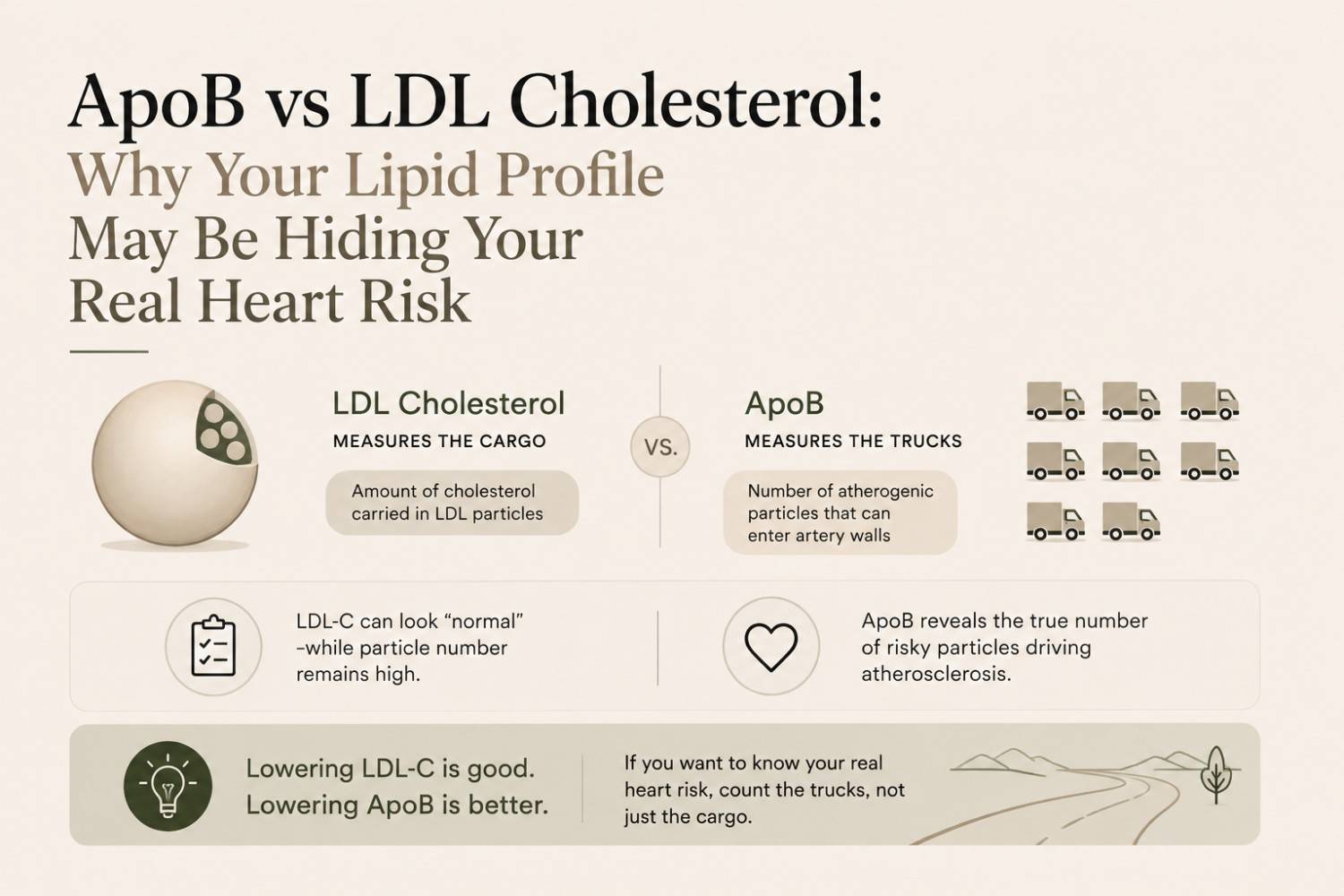
Every standard lipid profile reports LDL cholesterol as if it were a single, complete answer to the question "how is my heart risk?" It isn't. LDL cholesterol measures the amount of cholesterol carried inside a class of particles in your blood — but it says nothing about how many of those particles there actually are. That distinction, which sounds academic, turns out to be one of the more consequential gaps in routine cardiovascular screening.
What ApoB Actually Measures
Every LDL particle, along with VLDL and other atherogenic lipoproteins, carries exactly one molecule of apolipoprotein B on its surface. Measuring ApoB, therefore, gives you a direct count of the total number of potentially artery-damaging particles in your blood — regardless of how much cholesterol each particle happens to be carrying. This matters because it is the particles themselves, not the cholesterol they contain, that penetrate the arterial wall and initiate plaque formation.
How Two People Can Have the Same LDL and Different Risk
Imagine two people with an identical LDL cholesterol of 130 mg/dL. The first person's LDL is made up of a smaller number of large, cholesterol-rich particles. The second person's LDL is made up of a larger number of small, cholesterol-poor particles — a pattern common with insulin resistance and elevated triglycerides. The LDL number is the same. The ApoB number, and the actual arterial risk, is meaningfully higher for the second person. This "discordance" between LDL and ApoB is not rare; it shows up in a substantial proportion of people, and it is precisely the group that a standard lipid panel underestimates.
Who Discordance Tends to Affect Most
People with insulin resistance, prediabetes, or type 2 diabetes, where small dense LDL particles are more common.
People with elevated triglycerides, even when LDL cholesterol looks acceptable.
People with central/visceral obesity, independent of overall BMI.
People with metabolic syndrome, where the whole lipid pattern shifts toward smaller, denser particles.
If any of this describes you, an LDL number in the "acceptable" range should be interpreted cautiously rather than treated as reassurance. Our piece on what a standard blood panel misses covers several other markers in the same category.
Getting ApoB Tested in India
ApoB is a standard, validated blood test available at most major diagnostic labs in India, typically run from a fasting or non-fasting blood draw alongside a regular lipid profile. It is inexpensive relative to the clinical information it provides, and unlike some newer biomarkers, its use in cardiovascular risk assessment is well established internationally, including in guidance from several major cardiology bodies as a preferred marker for risk stratification in specific patient groups.
What to Do If Your ApoB Is High
The response is broadly similar to managing elevated LDL — dietary pattern, physical activity, weight management, and, where indicated, medication — but ApoB gives your physician a more precise target to track over time, particularly if your triglycerides are elevated or you have insulin resistance. This kind of interpretation is part of the expanded workup included in iMedi's longevity assessments, where lipid and metabolic markers are read together rather than in isolation.
How Diet Specifically Moves ApoB
Not all dietary changes affect ApoB equally. Reducing refined carbohydrate and added sugar intake tends to lower ApoB more reliably than simply reducing dietary fat, because excess carbohydrate, particularly in someone with insulin resistance, drives the liver to produce more of the small, dense, ApoB-rich particles described above. Replacing refined carbohydrate with fibre-rich vegetables, legumes, and whole grains, along with regular aerobic exercise, tends to shift the particle pattern toward larger, less atherogenic particles even before total cholesterol changes meaningfully. This is one reason two people who both "eat healthy" by their own definition can see very different ApoB results — the specific composition of the diet matters more than simply cutting calories.
When Medication Enters the Conversation
For people with significantly elevated ApoB, particularly alongside other risk factors like a family history of early heart disease, diabetes, or existing cardiovascular disease, lifestyle changes alone may not be enough, and statins or other lipid-lowering medications may be appropriate. ApoB is increasingly used by cardiologists internationally as a treatment target in its own right, sometimes considered a more precise guide to medication dosing than LDL cholesterol, particularly when LDL and ApoB disagree. This decision should always be made with a physician who can weigh your full risk profile, not from a single test result in isolation.
Why Indian Adults Should Pay Particular Attention
South Asian populations, including Indian adults, have been repeatedly shown in population research to develop cardiovascular disease at a younger age and at a lower BMI than many other populations, and a pattern of smaller, denser LDL particles alongside elevated triglycerides and lower HDL is a well-documented part of that picture. This means the LDL-versus-ApoB discordance described above may be more common, not less, in Indian adults, which is a strong argument for including ApoB in a preventive workup earlier rather than waiting until standard risk factors become abnormal.
Family history adds another layer worth considering carefully. If a parent or sibling had a heart attack or stroke before age 55 (men) or 65 (women), that history alone is a strong enough signal to justify ApoB testing regardless of how your standard lipid profile looks, since inherited patterns of particle number and size don't always show up clearly in total cholesterol or LDL cholesterol alone. Pairing ApoB with hs-CRP gives an even fuller picture of cardiovascular risk, since particle number and inflammation act through related but distinct mechanisms.
Frequently Asked Questions (FAQs)
1. Does fasting matter for an ApoB test?
Unlike a traditional lipid panel, ApoB is generally considered reliable even without fasting, though your physician may still recommend a fasting draw if other markers are being tested at the same time.
2. Is ApoB more accurate than LDL cholesterol?
For predicting cardiovascular risk, ApoB is generally considered at least as accurate as LDL cholesterol, and more accurate specifically in people with insulin resistance, elevated triglycerides, or diabetes, where LDL and ApoB commonly disagree.
3. Do I need both LDL and ApoB tested?
Most physicians will still look at your full standard lipid panel alongside ApoB, since triglycerides and HDL provide additional context that ApoB alone doesn't capture.
4. How much does an ApoB test cost in India?
It varies by lab, but ApoB is generally priced comparably to other specialised lipid markers and is available at most major diagnostic chains without requiring a doctor's prescription in many states.
5. Can diet and exercise lower ApoB?
Yes. Reducing refined carbohydrate and added sugar intake, increasing fibre, regular aerobic and resistance exercise, and weight loss where relevant can all reduce ApoB, often before LDL cholesterol shows the same improvement.
6. Is a normal LDL with high ApoB something to worry about?
It's worth discussing with a physician rather than dismissing. This pattern, sometimes called 'discordance,' is one of the more common reasons cardiovascular risk gets underestimated by a standard lipid panel alone.
7. Who should specifically ask for an ApoB test?
Anyone with a family history of early heart disease, insulin resistance, elevated triglycerides, prediabetes or diabetes, or central obesity is a reasonable candidate, even if their standard LDL cholesterol looks normal.
This article is for educational purposes and does not replace personalized medical advice. Please consult a qualified physician before making changes to your treatment, medication, or health screening plan.