HbA1c 5.7 to 6.4: What Prediabetes Really Means (and the Years Before It)
A 'borderline' HbA1c is not an early warning. It's a late one. Here's what actually happens in the years before it, and how to catch the problem sooner.
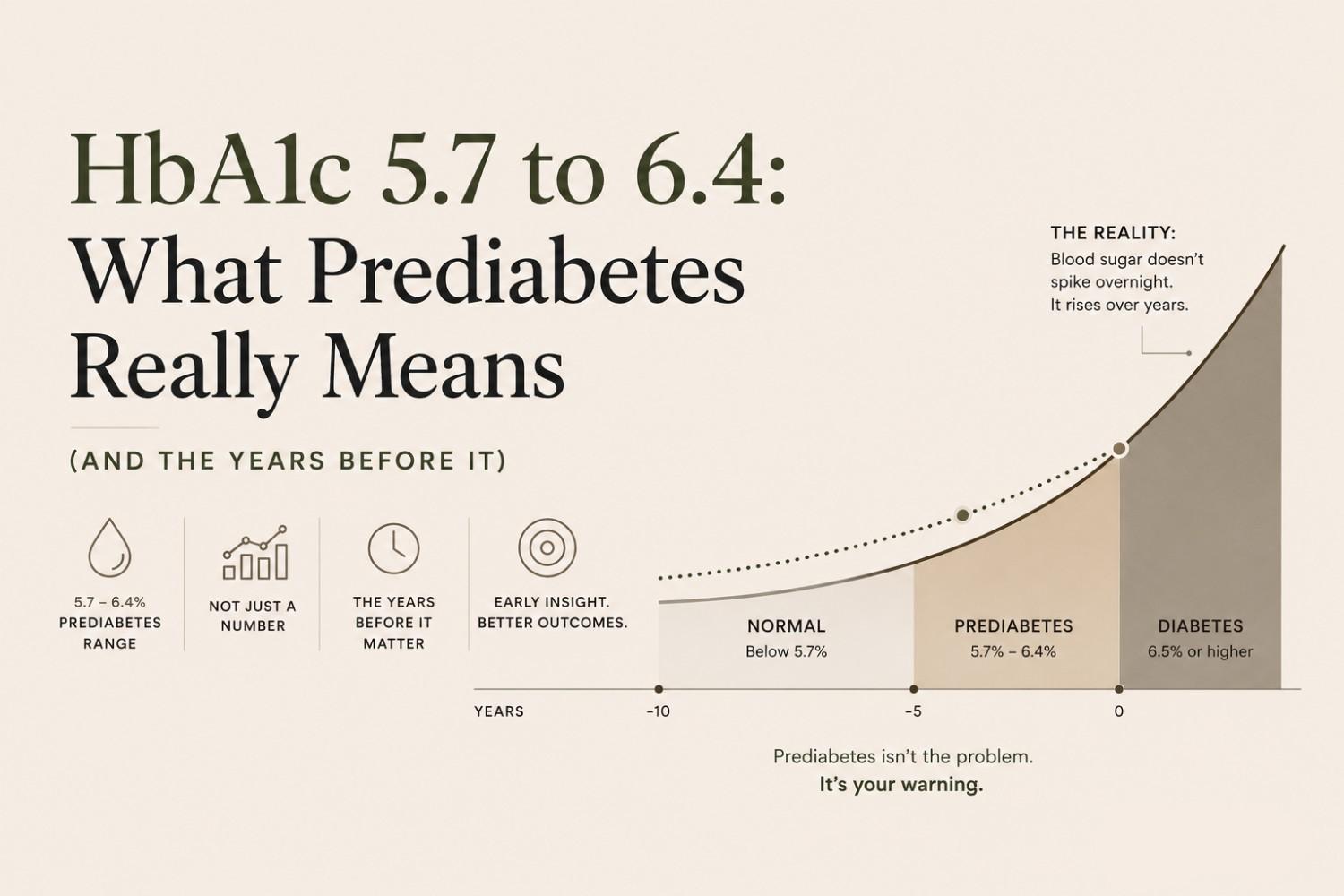
An HbA1c report that comes back at 5.8% or 6.1% often gets filed away as "borderline, keep an eye on it." That framing undersells what the number is actually telling you. HbA1c between 5.7% and 6.4% is the clinical definition of prediabetes, and the honest way to think about it is this: it is not an early warning sign. It is a comparatively late one.
What HbA1c Actually Measures
HbA1c reflects the percentage of your red blood cells' hemoglobin that has glucose attached to it, which gives a rough average of your blood sugar over the preceding two to three months, based on the roughly 120-day lifespan of a red blood cell. It is a useful screening number precisely because it isn't affected by what you ate for breakfast — but that same property means it is a lagging indicator. By the time it crosses 5.7%, the metabolic process that produced it has usually been underway for years.
The Years Before HbA1c Rises
Type 2 diabetes doesn't begin with high blood sugar. It begins with insulin resistance: your cells become progressively less responsive to insulin's signal to take up glucose, so your pancreas compensates by producing more insulin to force the same result. For a long time, this compensation works — glucose and HbA1c stay in the "normal" range purely because insulin output is rising to cover for the resistance. Research tracking this progression suggests insulin resistance can be measurable five to ten years before HbA1c itself becomes abnormal. Our article on fasting insulin and HOMA-IR covers how to test for this stage directly, rather than waiting for glucose to reflect it.
This is why two people can both have a "normal" HbA1c of 5.4%, and one of them is metabolically healthy while the other is deep into insulin resistance with a pancreas working overtime. Glucose and HbA1c are the last dominoes to fall, not the first.
What a Result of 5.7–6.4% Should Actually Trigger
A fasting insulin test. This shows how hard your pancreas is working to hold glucose where it is, and is more informative at this stage than glucose alone.
A closer look at waist circumference and visceral fat, since central adiposity is one of the strongest drivers of insulin resistance.
A structured plan around resistance training and post-meal walking, both of which directly improve insulin sensitivity independent of weight loss.
A review of ultra-processed carbohydrate intake and meal sequencing — the order in which you eat protein, fibre, and carbohydrate at a meal measurably affects the glucose spike that follows.
Repeat testing in three to six months, not twelve, so you can actually see whether the trend is moving in the right direction.
Is Prediabetes Reversible?
For most people caught in the 5.7–6.4% range, yes, with consistent effort. Because this stage still reflects compensated insulin resistance rather than pancreatic exhaustion, improvements in diet quality, physical activity, sleep, and body composition can measurably lower HbA1c within three to six months. The window narrows the longer the number sits unaddressed, which is exactly why "borderline, keep an eye on it" is the wrong response. Our disease reversal programme is built around exactly this window — using it while it's still open rather than waiting for a diabetes diagnosis to act.
When HbA1c Can Be Misleading
HbA1c is a reliable average in most people, but it isn't infallible, and it's worth knowing where it can mislead. Conditions that shorten or lengthen red blood cell lifespan can skew the result in either direction: iron deficiency anemia and certain hemoglobin variants (relevant in India given the prevalence of thalassemia trait) can falsely raise HbA1c, while recent blood loss, hemolytic conditions, or recent blood transfusion can falsely lower it. Pregnancy also affects red blood cell turnover and makes HbA1c less reliable as a standalone marker for gestational diabetes screening, which is why fasting and post-meal glucose tests are used instead during pregnancy.
This is one more reason HbA1c is best interpreted alongside fasting glucose and, where indicated, fasting insulin, rather than as a single number in isolation. If your HbA1c result doesn't match your fasting glucose in a way that seems unusual, or you have a known blood disorder, it's worth flagging to your physician rather than assuming the HbA1c is the definitive answer.
Family History Changes the Calculus
If a parent or sibling has type 2 diabetes, your own risk is substantially elevated even at an HbA1c that would otherwise be considered low-normal, and it's reasonable to start monitoring earlier and more closely than general population guidelines suggest. In practice, this often means annual testing from your late 20s or early 30s rather than waiting until your 40s, along with the fasting insulin testing described above, since family history is one of the strongest predictors of exactly the kind of silent, years-long insulin resistance that precedes an abnormal HbA1c. The same expanded panel covered in our article on what a standard blood test misses is a reasonable starting point for anyone in this higher-risk category.
Diet Sequencing: A Small Change With a Real Effect
One of the simpler, evidence-backed changes worth adopting immediately, regardless of where your HbA1c currently sits, is meal sequencing: eating vegetables and protein before carbohydrates in the same meal, rather than carbohydrates first or all foods mixed together. Research on post-meal glucose response has repeatedly shown this simple reordering, with no change in total calories or food choices, can meaningfully blunt the glucose spike that follows a meal. It costs nothing, requires no equipment, and is one of the few dietary interventions that shows a measurable effect within a single meal rather than requiring weeks to see a result.
Frequently Asked Questions (FAQs)
1. Is an HbA1c of 5.8% something to worry about?
It falls in the prediabetes range (5.7-6.4%) and is worth acting on, but it is also a stage where lifestyle changes are usually highly effective. The concern is complacency, not the number itself.
2. Can I have insulin resistance with a completely normal HbA1c?
Yes, this is extremely common. Insulin resistance typically develops years before HbA1c rises, because the pancreas compensates with higher insulin output to keep glucose in range.
3. What is the difference between prediabetes and diabetes?
Diabetes is diagnosed at an HbA1c of 6.5% or higher on two separate occasions, or a fasting glucose of 126 mg/dL or above. Prediabetes (5.7-6.4%) reflects an earlier, generally more reversible stage.
4. How quickly can HbA1c improve with lifestyle changes?
Meaningful improvement is often visible within three to six months of consistent changes to diet, activity, and sleep, though the exact timeline varies by individual.
5. Should I get a fasting insulin test even if my glucose is normal?
If you have risk factors such as central obesity, a family history of diabetes, or PCOS, a fasting insulin test can reveal insulin resistance well before glucose or HbA1c change.
6. Does losing weight always lower HbA1c?
Weight loss generally helps, but the composition of that weight loss matters. Losing muscle mass along with fat can blunt the metabolic benefit, which is why resistance training is recommended alongside any weight-loss plan.
This article is for educational purposes and does not replace personalized medical advice. Please consult a qualified physician before making changes to your treatment, medication, or health screening plan.