Fasting Insulin: The Most Useful Test Almost Nobody Orders
Your glucose can be perfectly normal while your insulin is already working overtime. This is the test that catches metabolic dysfunction at its earliest, most reversible stage.
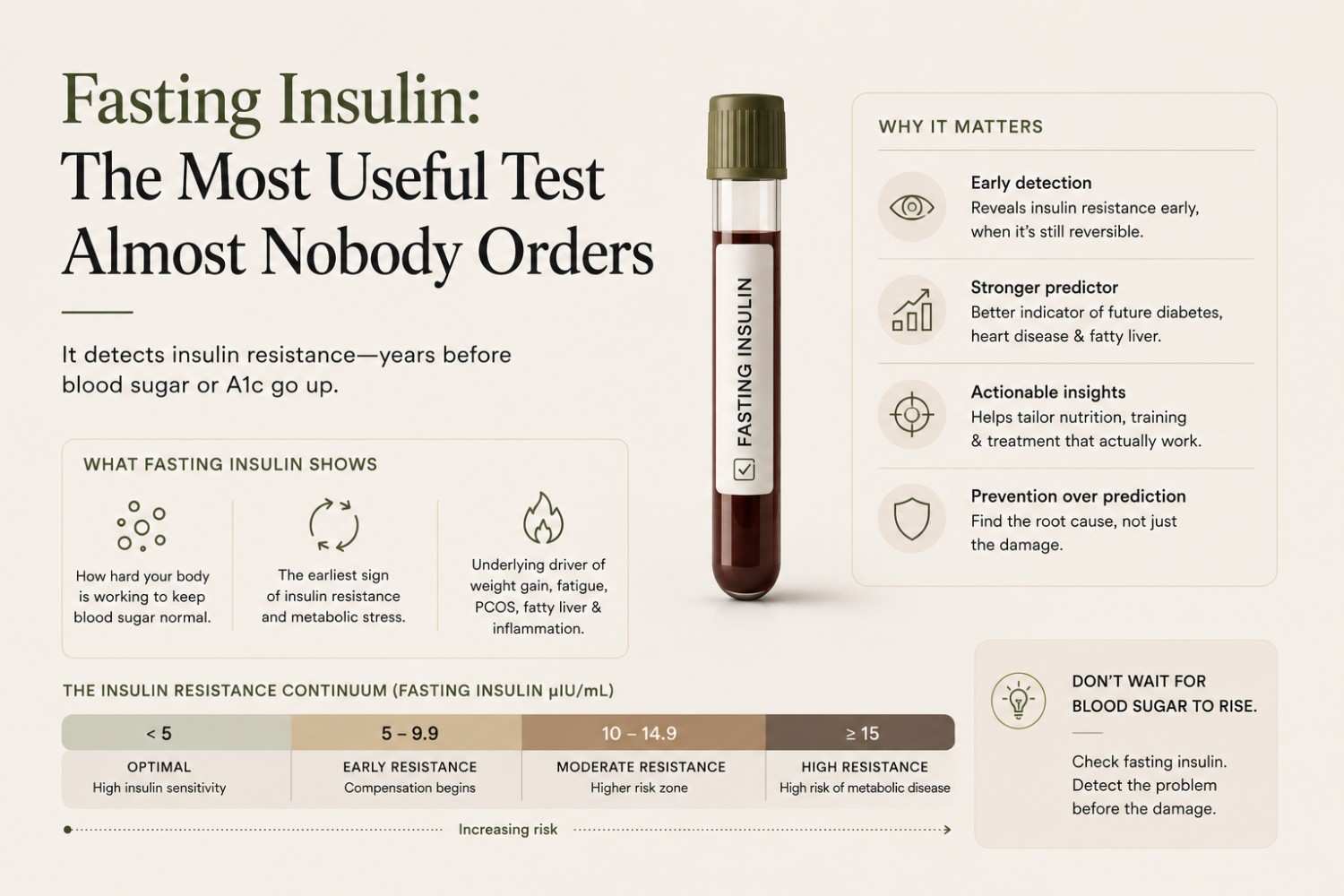
If you had to pick just one single blood test that reveals underlying metabolic dysfunction earliest, well before glucose changes, before HbA1c changes, before weight visibly shifts, fasting insulin would be a strong candidate. And yet it is almost never included in a standard health package in India. Most people have never had it measured, and many doctors only order it once glucose has already started to drift upward — which is, unfortunately, well past the point where it's most useful.
Why Insulin Rises Before Glucose Does
Insulin's job is to help your cells take up glucose from the bloodstream. When cells become resistant to insulin's signal, typically driven by excess visceral fat, physical inactivity, chronic stress, or genetics, the pancreas compensates by producing more insulin to force the same glucose-lowering effect. For years, this compensation works well enough to keep fasting glucose and HbA1c looking completely normal. The cost of that compensation is chronically elevated insulin, which itself drives fat storage, suppresses fat burning, and is associated with fatigue, particularly the kind of energy crash that hits an hour or two after a carbohydrate-heavy meal.
What HOMA-IR Is and How to Read It
HOMA-IR (Homeostatic Model Assessment of Insulin Resistance) is a simple calculation using your fasting glucose and fasting insulin together:
HOMA-IR = (Fasting Glucose in mg/dL × Fasting Insulin in µIU/mL) ÷ 405
As a general guide, a HOMA-IR below 1.0 suggests good insulin sensitivity, 1.0–1.9 is often considered normal to borderline, and above 2.0–2.5 typically indicates a meaningful degree of insulin resistance, though exact cutoffs vary somewhat between labs and populations. What makes HOMA-IR valuable is that it can flag a problem using glucose and insulin values that individually still look "normal" — exactly the scenario covered in our piece on what a standard blood panel misses.
Who Should Get This Tested
Anyone with central/visceral fat accumulation, regardless of overall body weight.
Anyone with a family history of type 2 diabetes.
Women with PCOS, where insulin resistance is a core driver in most cases.
Anyone whose HbA1c sits at the upper end of "normal" (5.5–5.6%) or in the prediabetes range, as covered in our article on HbA1c 5.7–6.4%.
Anyone experiencing unexplained fatigue, particularly after carbohydrate-heavy meals, or difficulty losing weight despite consistent effort.
Improving Insulin Sensitivity
Unlike some metabolic markers, insulin sensitivity responds quickly and meaningfully to a relatively short list of interventions: resistance training (which increases glucose uptake by muscle independent of insulin), a 10–15 minute walk after meals, adequate sleep, reduced intake of refined carbohydrates and sugar-sweetened beverages, and, where relevant, meaningful reduction in visceral fat. Several of these changes can produce a measurable improvement in HOMA-IR within eight to twelve weeks. This is precisely the mechanism behind our weight loss and disease reversal programmes, both of which use fasting insulin and HOMA-IR as core tracking metrics rather than weight alone.
Fasting Insulin and PCOS
Insulin resistance is present in a large majority of women diagnosed with PCOS (polycystic ovary syndrome), including many who are not overweight at all, and it is often a central driver of the irregular cycles, acne, and excess hair growth associated with the condition, rather than simply a downstream consequence of it. For women with PCOS, fasting insulin and HOMA-IR are arguably more clinically useful than glucose or HbA1c alone, since insulin resistance frequently predates any measurable change in blood sugar by years, and addressing it directly often improves cycle regularity and other symptoms independent of weight change.
Limitations Worth Knowing
Fasting insulin assays are less standardised across labs than glucose tests, meaning results and reference ranges can vary somewhat depending on which lab and assay method is used, which is why trends over time from the same lab are often more informative than a single number compared against a general population cutoff. The test also requires a true fasting state, typically 8–12 hours, and results can be affected by recent illness, significant stress, or poor sleep the night before, so it's worth testing under reasonably typical conditions and repeating if a result seems inconsistent with the rest of your clinical picture.
Post-Meal Glucose as a Complementary Check
For a fuller picture between annual blood draws, some physicians recommend an occasional post-meal glucose check, either with a standard glucometer one to two hours after a typical carbohydrate-containing meal, or over a short period with a continuous glucose monitor. A pattern of glucose regularly climbing above roughly 140 mg/dL after meals, even with a normal fasting glucose and HbA1c, can be an early practical sign of the same insulin resistance that fasting insulin and HOMA-IR are designed to catch, and it's a useful, low-cost way to see the effect of specific meals and meal-sequencing changes in real time.
It's worth pairing this test with the same meal-sequencing strategy covered in our article on HbA1c and prediabetes: eating vegetables and protein before carbohydrates in a meal, then checking the post-meal glucose response, gives a very direct, personal demonstration of how much a simple ordering change can blunt an individual glucose spike. Many people find this kind of immediate feedback more motivating than an annual lab report, precisely because the effect of a single changed habit becomes visible within hours rather than months, which makes it considerably easier to stay motivated and consistent with the change over the following several weeks and months.
Frequently Asked Questions (FAQs)
1. Does stress affect fasting insulin results?
Yes, acute physical or psychological stress can temporarily raise insulin levels, which is another reason to test under reasonably typical, non-acute conditions and to consider repeating an unexpected result.
2. What is a normal fasting insulin level?
Reference ranges vary by lab, but many aim for a fasting insulin below roughly 10 uIU/mL, with lower values generally indicating better insulin sensitivity. Your physician will interpret this alongside your fasting glucose using HOMA-IR.
3. Can I calculate HOMA-IR myself?
Yes, the formula is (fasting glucose in mg/dL x fasting insulin in uIU/mL) / 405, but interpretation should be done with a physician who can factor in your broader health picture.
4. Is fasting insulin testing available in India?
Yes, it is a standard test available at most major diagnostic labs, though it isn't automatically included in most routine health packages and usually needs to be requested specifically.
5. Can I have insulin resistance even if I'm not overweight?
Yes. This is sometimes called 'lean insulin resistance' and is more common than assumed, particularly with high visceral fat relative to overall body weight, sedentary lifestyle, or genetic predisposition.
6. How is fasting insulin different from a glucose tolerance test?
A glucose tolerance test measures how your blood sugar responds to a glucose load over time. Fasting insulin, particularly combined into HOMA-IR, estimates how hard your pancreas is working at rest, often catching resistance earlier.
7. How quickly can insulin sensitivity improve?
With consistent resistance training, post-meal walking, and dietary changes, measurable improvement in HOMA-IR is often seen within 8-12 weeks.
This article is for educational purposes and does not replace personalized medical advice. Please consult a qualified physician before making changes to your treatment, medication, or health screening plan.